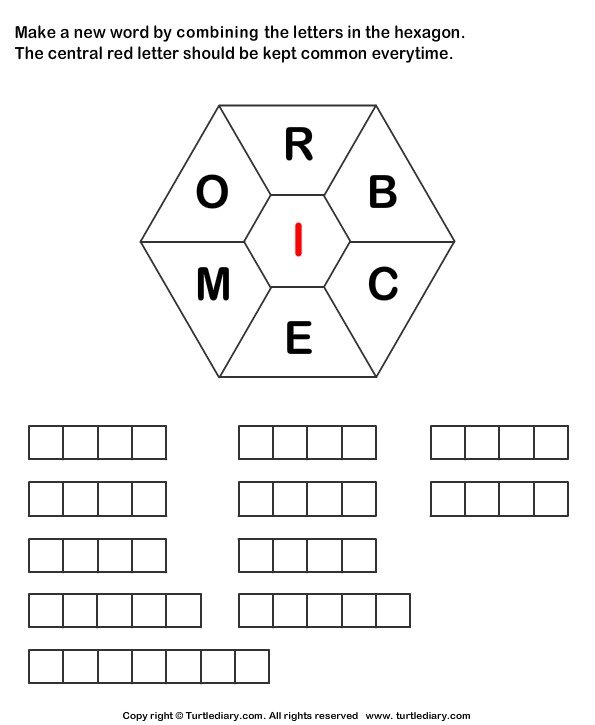
When you are asked to build a word from these letters, the task may look simple at first, but it often requires a mix of pattern recognition, vocabulary knowledge, and strategic thinking. Whether it is a puzzle game, an exam question, or a casual brain teaser, the ability to quickly rearrange letters into meaningful words can save time and improve accuracy. Many people struggle because they try to guess randomly instead of following a structured approach.
At its core, this skill is about recognizing combinations of letters that naturally form valid words. English words follow certain patterns, and once you understand these patterns, you can solve even complex letter arrangements efficiently. The phrase build a word from these letters represents more than just rearrangement; it reflects a mental process of decoding and organizing information.
Start by Identifying Vowels and Consonants
A practical first step when you need to build a word from these letters is separating vowels and consonants. Vowels such as A, E, I, O, and U often act as anchors in English words. By identifying them early, you can start forming possible word structures.
For example, if you see a set of letters like T, R, E, A, P, you immediately notice the vowels E and A. This helps you test combinations like “PEAR” or “TEAR.” Without this step, your brain might waste time trying random arrangements.
This method is especially useful in timed games or tests where you must quickly build a word from these letters without hesitation.
Look for Common Word Patterns
Another powerful strategy is recognizing common word patterns. English has many repeated structures such as “-ing,” “-ed,” “re-,” “un-,” and “-tion.” When you are trying to build a word from these letters, spotting these patterns can guide your thinking.
For instance, if your letters include R, E, A, D, and I, you might quickly see “READ” or “RED.” If you add another letter like N or G, you could form “READING” or “DEARING” depending on context.
Training your mind to see these patterns reduces mental effort and speeds up the process significantly.
Rearrangement Through Trial Combinations
Sometimes the fastest way to build a word from these letters is simply by experimenting with combinations. Start with short groups of two or three letters and gradually expand them.
For example, take letters S, T, O, N, E:
You might try:
ST + ONE = STONE
SON + TE = (invalid)
Then rearrange until you find the correct match.
This trial-and-error approach works well when your brain cannot immediately recognize a pattern. Over time, you become faster because your memory stores successful combinations.
Use Mental Word Banks
A useful technique is maintaining a mental word bank. This means remembering common words that frequently appear in puzzles or daily language. When you try to build a word from these letters, your brain automatically scans this mental dictionary.
Words like “stone,” “train,” “table,” “plane,” and “river” often appear in rearrangement puzzles. The more words you are familiar with, the easier it becomes to match them with given letters.
Expanding your vocabulary is one of the most effective long-term ways to improve your ability to build a word from these letters quickly.
Focus on Letter Frequency
Another helpful strategy is understanding letter frequency in English. Some letters appear more often than others, such as E, T, A, O, and N. When you are given random letters, these high-frequency characters often play a key role in forming valid words.
If you are trying to build a word from these letters and you see multiple common letters, you can prioritize them in your arrangement. For example, with letters E, T, A, S, R, the word “STARE” or “TEARS” becomes easier to identify.
This method reduces guesswork and increases logical decision-making.
Break Longer Words into Smaller Parts
When dealing with longer sets of letters, breaking them into smaller chunks is extremely useful. Instead of trying to solve everything at once, divide the letters into smaller word-like segments.
For example, if you are trying to build a word from these letters: C, O, M, P, L, E, T, E, you can break it into COM + PLETE, which helps you quickly identify “COMPLETE.”
This segmentation technique trains your brain to see structure instead of chaos, making the process much faster.
Practice with Anagram Exercises
Regular practice is essential if you want to master the ability to build a word from these letters efficiently. Anagram exercises help train your brain to recognize patterns faster.
You can start with simple five-letter puzzles and gradually move to more complex ones. Over time, your reaction speed improves, and you begin to recognize word formations instantly without much effort.
Games like Scrabble, Wordscapes, and other word puzzles are also excellent tools for practice.
Use Elimination Strategy
When you are stuck, elimination can be very powerful. Instead of focusing on what works, start identifying what clearly does not work.
If you are trying to build a word from these letters and certain combinations make no sense in English, eliminate them immediately. This reduces mental clutter and helps you focus on more likely possibilities.
For example, if letters are A, R, T, E, L, you can quickly eliminate combinations like “TAREL” if it does not match known words and focus on “LATER” or “ALERT.”
Think in Terms of Word Families
Word families are groups of words that share similar structures. If you know one word, you can often rearrange letters to form related words.
For example:
ACT → CAT, TAC (valid structure variations)
EAT → TEA, ATE
When trying to build a word from these letters, thinking in families helps you explore multiple valid solutions faster.
Conclusion: Mastering Speed and Accuracy
Learning how to build a word from these letters is not just a fun mental exercise; it is a valuable cognitive skill that improves memory, vocabulary, and problem-solving ability. By using strategies like separating vowels and consonants, recognizing patterns, practicing anagrams, and breaking down complex letter groups, you can significantly increase your speed.
With consistent practice and the right techniques, anyone can become efficient at solving letter rearrangement puzzles. The key is to stay systematic rather than random, allowing your brain to naturally adapt to patterns over time. Eventually, when you see any set of letters, you will instantly know how to build a word from these letters without hesitation.
About the Author